Making connections
From remote Alaskan outposts to Carnegie Mellon’s urban campus, how Alex Hills spent a career bringing people together through technology.
Hillary Roman
Nov 4, 2026

Bridging the Alaskan divide
In 1976, Kotzebue, Alaska, population 1800, a young Alex Hills was reading an issue of IEEE Spectrum where he found a small advertisement for a newly launched Carnegie Mellon University Ph.D. program in “Engineering and Public Affairs” that would change his future and the future of global connectivity.
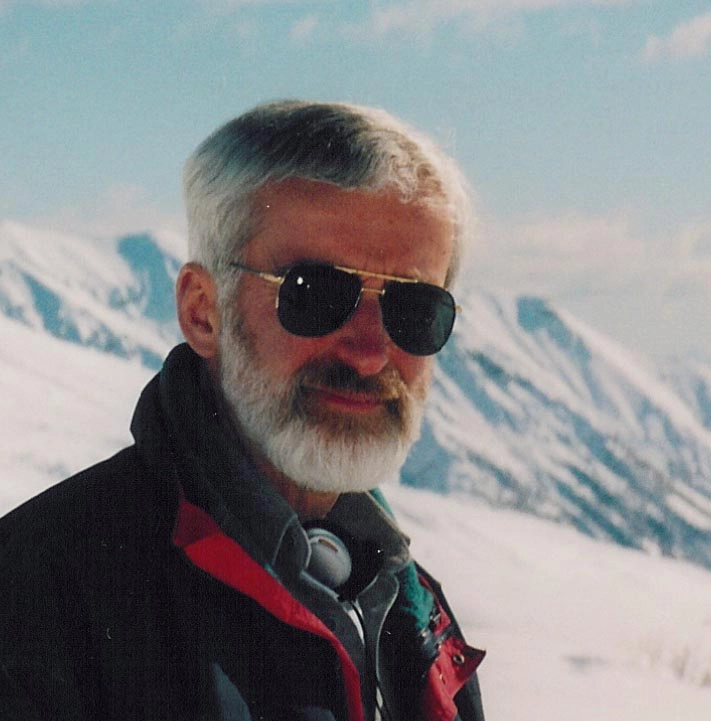
Hills, a former Army Signal Corps officer, had been working to build a telephone system to serve the many isolated Indigenous villages spread across rural Alaska. Informed by his service experience aiding developing communities in South Korea, he recognized the issues Alaska Natives were facing. “Rural Alaska was a lot like a developing nation,” he remembered. The healthcare system relied on village health aides who consulted doctors in regional hospitals by shortwave radio. That far north, shortwave signals can be disrupted by a number of challenging factors, including the northern lights.
Satellites offered a promising solution, but standard infrastructure was far too large and expensive. Hills and his colleagues convinced corporate executives to use compact satellite earth stations at a fraction of the cost. This innovation proved to be the breakthrough; for the first time, each village had access to a telephone.
I got to the point where my engineering education wasn’t enough.
Alex Hills, Distinguished Service Professor, Engineering and Public Policy
Building on the satellite success, Hills assisted with the launch of a local cooperative that brought individual telephone exchanges to ten northwest Alaskan villages, providing the opportunity for every household to have a phone of their own. As the cooperative’s elected president, he built an operational blueprint that other rural communities across the state could copy.
But the work hit a wall. “I got to the point where my engineering education wasn’t enough,” said Hills. The telephone cooperative was successful, but he started to run into the intractable problems of economics, law, finance, and regulation. He realized that large-scale regional improvements are more than just an engineering problem.
Source: Courtesy of Alex Hills' personal collection
EPP’s first Ph.D.
Hills thought the IEEE Spectrum ad could offer the solution. “I liked the name ‘Engineering and Public Affairs’ because it sounded like using engineering to help people,” he said. He wrote to Granger Morgan to inquire about the program, and by 1977 he had moved his young family to Pittsburgh. Hills joined a cohort of engineers from different disciplines united by a desire to address the non-technical complexities of societal challenges.
I liked the name ‘Engineering and Public Affairs’ because it sounded like using engineering to help people.
Alex Hills , Distinguished Service Professor, Engineering and Public Policy
Hills had the distinction of becoming what was now the Engineering and Public Policy (EPP) department’s first Ph.D. graduate in 1979. When people ask him how he finished so quickly, he credits his experience in broadcasting. “When you see the second hand sweeping toward the end of the hour, it’s time to finish up,” he laughed.
The Information Networking Institute
Hills moved back to Alaska, becoming the state’s top telecommunications official. There, he continued the work of connecting rural communities to communication resources for nearly a decade. In 1988, Morgan asked for his help. EPP professor Marvin Sirbu had written a winning proposal to Bellcore (a major research and development organization created after the federally ordered breakup of the Bell System) to create the Information Networking Institute (INI). Bellcore hoped that the new institute would inspire electrical engineers, computer scientists, and business professionals, then working in their own silos, to broaden their interests and become information networking specialists.
After securing the Bellcore opportunity, CMU faced the dual challenges of finding INI’s first director and creating two new degree programs within nine short months. Hills accepted the role as director and, together with Sirbu, established the M.S. in Information Networking and a non-degree program for Bellcore employees.
Wireless Andrew becomes the wireless world
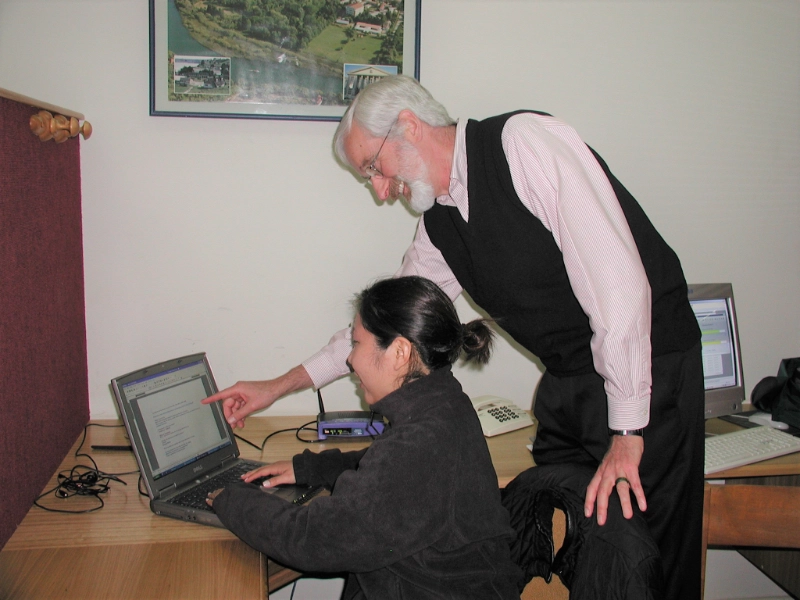
Source: Carnegie Mellon University Archives
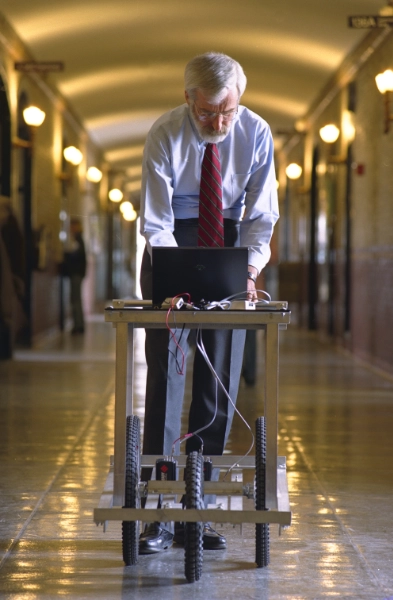
Hills testing the coverage of Wireless Andrew in Baker Hall
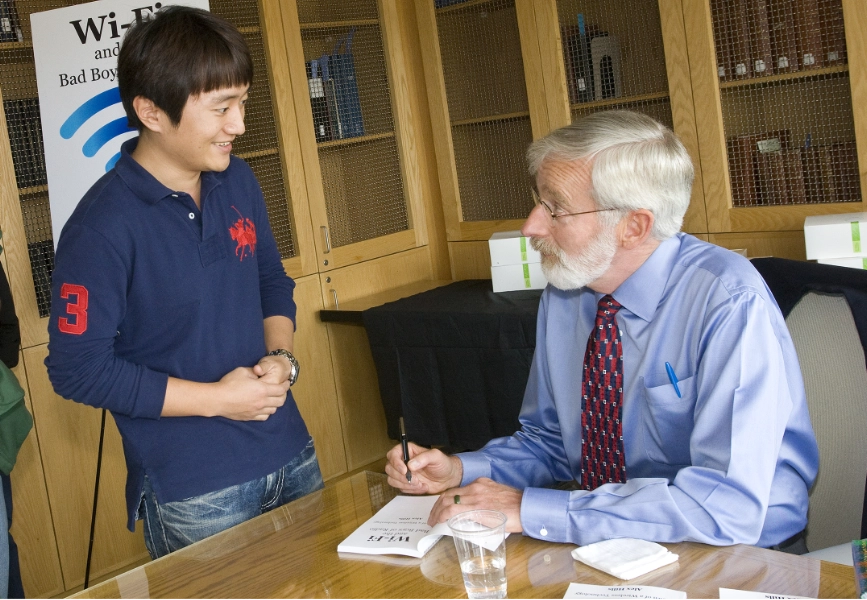
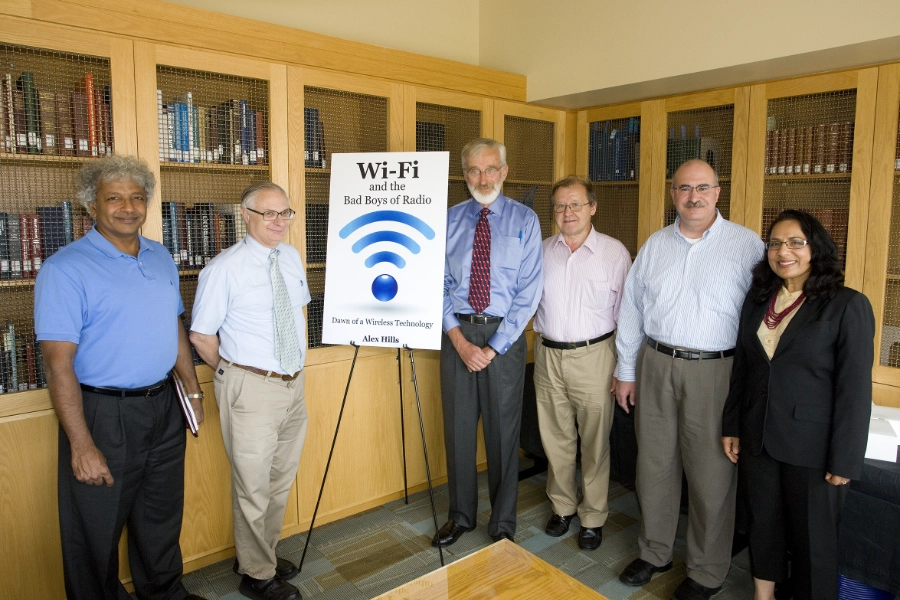
Hills and Sirbu continued to collaborate, creating INI’s wireless initiative to deliver “information anytime, anywhere.” Engineering and computer science professors were working on the hardware and software needed to allow mobile computing, but they needed a wireless testbed to support their efforts. In his book, Wi-Fi and the Bad Boys of Radio: Dawn of a Wireless Technology, Hills details how a $550,000 National Science Foundation grant enabled his team to build a two-floor testbed in Wean Hall—a project that eventually expanded into Wireless Andrew, the world’s first campus-wide Wi-Fi network.
Initially slow with uncertain capacity, the INI team restricted access to the network to ensure bandwidth for their research. “But CMU students are smart,” said Hills. “They figured out how to hack their way onto the network.” It was at that moment he realized the immense global trajectory wireless internet would take. By that time, Hills had been appointed vice provost and chief information officer at CMU, which put him in the position to grow Wireless Andrew into a campus-wide service. He remembers that, years later, he saw a student aiming a laptop camera around a building to show off CMU’s wireless network to a friend at MIT. “There was a little competition there,” Hills mused, “but we were first.”
CMU students are smart. They figured out how to hack their way onto the network.
Alex Hills, Distinguished Service Professor, Engineering and Public Policy
Geeks on a mission
Hills remained steadfast in his conviction that technical innovation should serve human needs. In 2004, he joined fellow EPP alumnus and CMU teaching professor Joseph Mertz’s Technology Consulting in the Global Community (TCinGC) program as a senior advisor. Every summer, the program sends CMU students to developing nations for ten weeks. These students work as consultants to senior leaders in government agencies and NGOs, advising on technological challenges and other issues.
TCinGC continues to have a profound effect on both the students and communities they serve. Hills and five students documented their transformative experiences in the book, Geeks on a Mission: In Their Own Words.
There’s a practical reason for TCinGC’s informal name. Recognizing that few people remember its formal title, Hills coined another moniker. “It would often happen that when I was telling people about the program, a couple minutes later I would ask, ‘Now what was the name of that program?’ And they could never remember,” Hills chuckled. “I came up with Geeks on a Mission, because they always remember that."
Our program trains students to ask the question: ‘What’s going to happen after we leave?’
Alex Hills, Distinguished Service Professor, Engineering and Public Policy
Students gain something essential from working abroad. Engineers can be overly focused on fixing the technological aspects of a problem and may overlook sustainability. Hills has observed many well-meaning technology professionals make a similar mistake. “They may parachute in, build a system, and then leave,” Hills said. “Our program trains students to ask the question: ‘What’s going to happen after we leave?’”
EPP’s legacy
Reflecting on its 50th anniversary, Hills emphasizes EPP’s most vital lesson: technical solutions alone cannot solve society’s greatest challenges. His advice for today’s doctoral students tackling modern issues like AI governance and climate change is simple: “Remember your EPP training,” he said. “Remember all those other aspects of a project that go beyond just the engineering piece.” Across five decades of his career, from Arctic villages to Wireless Andrew to developing communities around the world, Hills has demonstrated that engineering reaches its highest purpose when it creates meaningful, lasting connections between people.