A game theoretic framework for satellite spectrum sharing
How “probabilistic look-aside” can help improve internet speeds for consumers
Hillary Roman
Jun 30, 2026

The Interference Problem
The space in Earth’s orbit has become crowded with satellites. Some companies are operating many non-geostationary orbit (NGSO) satellites that together form a constellation, providing broadband and other communications services. As more NGSO constellations are launched, more systems compete for the same frequency bands, creating a growing risk of harmful interference that can reduce data rates.
When satellites from different constellations serve the same region from roughly the same angle, operators may need to respond. They can: 1) take no action, allowing data rate degradation to passively occur; 2) “look-aside,” where a constellation determines that one of its satellites is at risk of a conflict and proactively assigns transmission to another one of its satellites; or 3) use “band-splitting,” where the available bandwidth is divided equally between operators. The Federal Communications Commission (FCC) has adopted band-splitting as the default approach when operators cannot agree to an alternative. Each of these strategies has drawbacks. Constellations taking no action at all can experience unnecessary interference; always utilizing look-aside means operators will have to switch transmissions to a satellite in a suboptimal position; and band-splitting, while ostensibly fair, reduces the available radio spectrum resulting in reduced internet speeds for subscribers.
Now that the number of satellites in orbit is increasing at an extraordinary rate, we need to invent new strategies that allow satellite constellations to operate in the same shared spectrum without excessively interfering with each other.
Jon Peha, Professor, Engineering and Public Policy, Carnegie Mellon University
Probabilistic Look-Aside
New research from Carnegie Mellon University offers a better solution. In the 2026 IEEE DySPAN Best Paper Award winning paper, “Limiting Mutual Interference Between NGSO Satellite Constellations via Probabilistic Look Aside,” Ganghui Lin, Jon Peha, Marvin Sirbu, and Alex Hills introduce a novel strategy they call “probabilistic look-aside.” Rather than always or never looking aside, satellite constellations can improve data-rate performance by using look-aside with a fixed probability when they detect a possible conflict based on satellite positions. In practical terms, the researchers propose a way for competing satellite operators to reduce harmful interference without needing detailed real-time coordination, relying instead on publicly available satellite position information.
This approach addresses a common dilemma: satellites may be physically in-line without actually causing harmful interference, but unless operators share more real-time information, it’s difficult for them to know which of these events will cause disruption. When operators play it safe by always looking aside, they sacrifice optimal satellite assignment unnecessarily. Probabilistic look-aside tries to strike a balance between avoiding interference and preserving performance. Using the principles of game theory, the researchers analyzed how often operators may choose to look aside, or what fixed probability they will use, when acting independently or cooperatively.
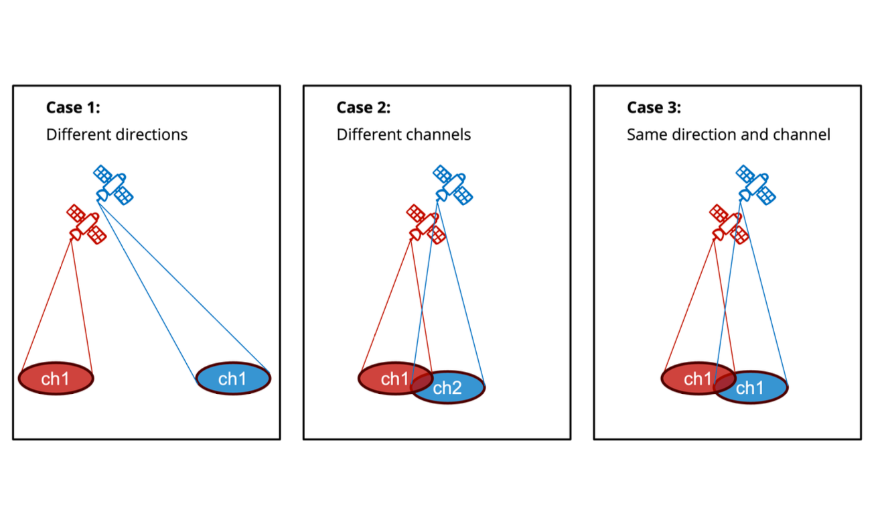
While all cases are physical in-line events, only Case 3 represents an interfering in-line event. In Case 1, the two cells are served in different directions with sufficient angular separation, allowing both operators to use the same frequency channel safely. In Case 2, although cells are served from similar directions, the operators use different frequency channels so there is no interference. Only in Case 3, where the satellites are physically in line, serve cells from the same direction, and simultaneously use the same frequency channel, does an interfering in-line event occur that requires mitigation.
Testing and Policy Implications
The researchers tested the idea in two scenarios: one involving two similarly sized large constellations, both with around 4,000 satellites, and another involving a large constellation of around 4,000 satellites and a smaller constellation of around 600 satellites. In the first scenario, two equally large constellations will have better outcomes using probabilistic look-aside whether working cooperatively or independently. If they work cooperatively, they will find a balanced Pareto frontier, where they can’t improve one constellation’s performance without degrading the other constellation’s performance. If they work independently, they will find Nash equilibria, meaning stable strategy choices where neither operator benefits from changing its decision alone.
In the second scenario, where one large and one small constellation compete for resources, probabilistic look-aside is the optimal strategy but for different reasons. When a large and small network compete, the larger network does most of the heavy lifting. Because it has thousands of satellites, it has plenty of backup options to switch to without losing performance. The smaller network, having fewer satellites, suffers a major penalty if it moves away from its best option. Game theory shows that the best outcome occurs when the large network frequently looks aside, while the small one stays put. Across the scenarios studied, the proposed method improved outcomes relative to no action, always look-aside, and band-splitting.
A Tunable Mechanism
Previous solutions to constellation interference have utilized blunt approaches that result in inefficiencies for all players. While it is easy to see why doing nothing fails and always looking aside is wasteful, the paper’s most surprising finding is that band-splitting produced the worst performance of all scenarios studied. This finding underscores important policy implications. The FCC’s default band-splitting rule gives operators a strong incentive to adopt better coordination mechanisms. Similarly, the United Nations’ International Telecommunications Union (ITU) uses a "first-come, first-served" framework, which creates entirely different incentives. Ultimately, the authors conclude that probabilistic look-aside gives operators an efficient, tunable way to share spectrum that requires no real-time coordination beyond publicly available satellite tracking data.
This research was presented at the IEEE International Symposium on Dynamic Spectrum Access Networks (DySPAN) and won the Best Paper Award in May 2026. Read the full paper: Limiting Mutual Interference Between NGSO Satellite Constellations via Probabilistic Look Aside